
Monsoon Property Defense – Fortifying Your Phoenix Home for Severe Storms
 Rick Rome
by Ryan Williams
The Monsoon Audit
Fortifying Your Property for High-Wind Microbursts
July 1, 2026
The transition into late summer across the Greater Phoenix region brings a dramatic shift in atmospheric dynamics. The dry, predictable heat of early summer gives way to surging tropical humidity, bringing sudden, violent localized thunderstorms known as monsoons. While the cooler evening downpours offer a brief respite from triple-digit temperatures, they also present serious structural hazards to unprotected properties. High-velocity straight-line winds, intense dust walls, sudden hail, and blinding microbursts can easily cause thousands of dollars in property damage in a matter of minutes.
For Valley homeowners, surviving the season with peace of mind requires moving far beyond basic indoor emergency supply kits. True resilience stems from a proactive, structural property audit designed to eliminate hidden weak points before the first severe storm warning flashes on your phone. By systematically securing your roof line, clearing critical landscape drainage pathways, and physically auditing your trees, you can safeguard your home investment and ensure your property effortlessly channels the brute force of nature.
Fortifying the Envelope: Advanced Roof and Flashing Inspections
The primary shield protecting your family and your structural equity from severe monsoon downpours is your home’s roof system. Whether your property utilizes a traditional concrete tile framework or a modern flat foam roof, the intense UV rays of the preceding months have already tested materials to their absolute limits. Small cracks or slightly compromised seals that go unnoticed during the dry spring will rapidly fail under the weight of a sudden two-inch downpour, leading to costly interior drywall and ceiling damage.
A comprehensive roof audit begins with a meticulous visual inspection of all perimeter edge flashings, valley channels, and penetrations. Pay close attention to the metal flashing surrounding plumbing vents, skylights, and your chimney structure, as these areas experience the highest rates of thermal expansion and seal degradation. If you have a tile roof, search for slipped, cracked, or missing tiles that expose the sensitive water-resistant underlayment underneath. For flat foam or modified bitumen roofs, check for localized blisters, cracking, or clogged scuppers that could trap standing water.
Crucially, you must clear all built-up organic debris, leaves, and desert dirt from your gutter networks and downspout collectors. A single blocked downspout will cause water to back up rapidly along the fascia board during an intense monsoon storm. This trapped water easily forces its way underneath your starter shingles or tile underlayment, triggering severe, hidden wood rot along your roof decking. For expert repairs or complex inspections, local homeowners regularly utilize trusted regional companies like Lyons Roofing, an award-winning Phoenix contracting team specializing in storm-damage mitigation and structural roofing system maintenance.
Engineering the Landscape: Clearing Micro-Drainage Channels
Once you have verified that your roof can shed water efficiently, your secondary focus must shift to where that water travels after it hits the ground. Monsoon downpours drop massive volumes of water in incredibly short periods, easily overwhelming standard city street gutters and municipal drainage grids. If your backyard landscape grading has settled over time, or if your property’s drainage swales are clogged with decorative rock or dense overgrowth, that water can pool against your home’s concrete slab foundation.
Standing water against a residential foundation is a major financial hazard that can lead to slab movement, interior flooring damage, and mold growth. To prevent this, walk your property line and ensure the soil or gravel slopes downward and away from your home’s perimeter walls for at least six feet. Inspect all existing backyard drainage swales, French drains, and catch basins to ensure they are completely free of weeds, plastic trash, and accumulated desert sand.
If your property utilizes specialized pop-up emitters near the street curb to vent backyard water, test the mechanical hinges to confirm they open freely under light pressure. Homeowners dealing with complex grading issues or seeking professional landscape erosion control often contact experienced local design teams like Straight Line Landscape, a highly rated Valley firm that specializes in grading adjustments and structural drainage installations across Maricopa County.
Air-Pruning the Canopy: Mitigating High-Wind Tree Failures
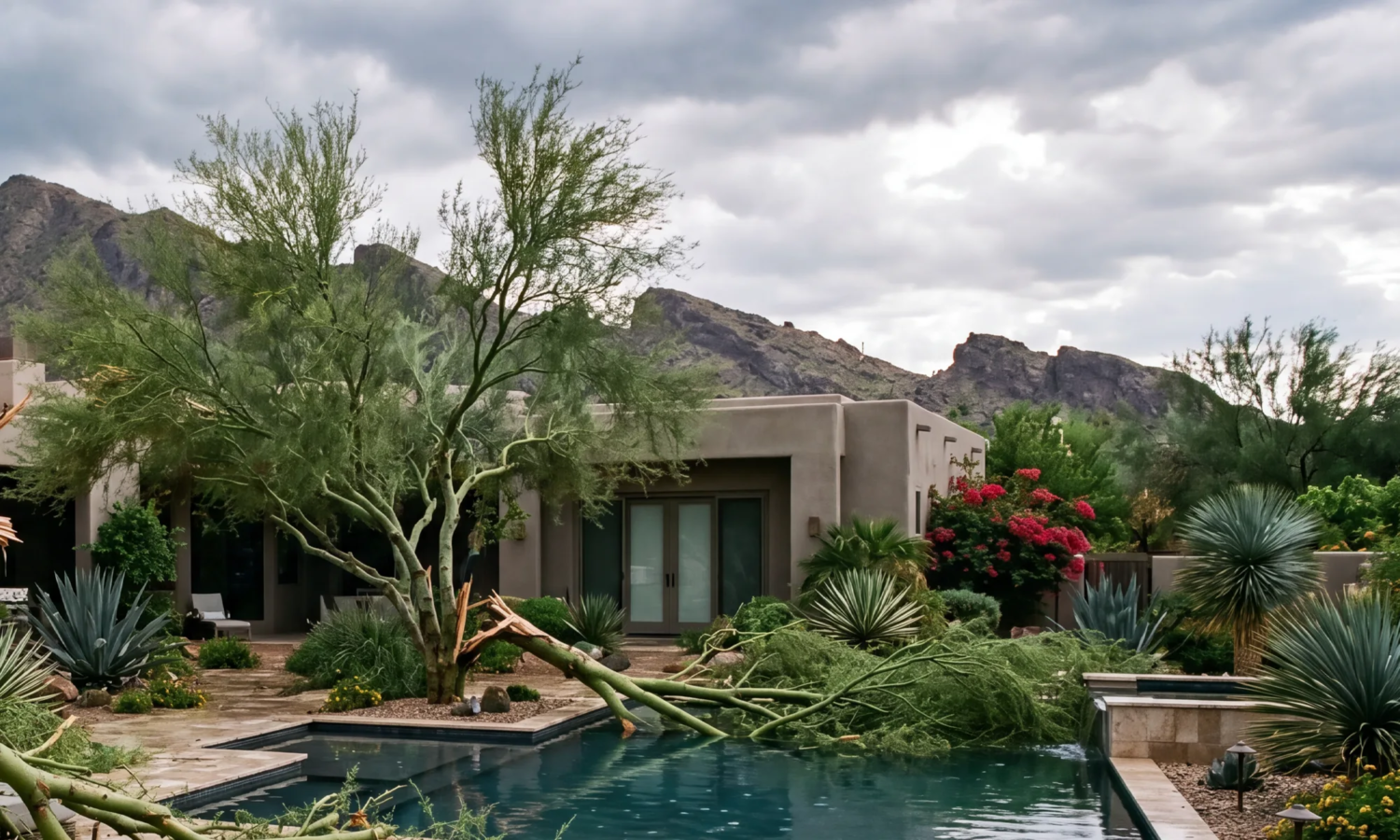
Perhaps the most visible and dramatic casualty of a severe Phoenix microburst is a uprooted tree blocking a neighborhood street or resting on a neighbor’s roof line. Fast-growing, non-native desert trees—such as standard Chilean Mesquites, African Sumacs, and dense Palo Verdes—are highly susceptible to wind-tipping during late summer storms. Because these trees grow rapidly, they naturally develop thick, sail-like canopies that completely catch the wind instead of letting it pass through safely.
To prevent structural tree failures, homeowners should employ a specific landscape technique known as crown thinning or “air-pruning.” Instead of aggressively topping a tree, which weakens its structural integrity and triggers rapid, weak branch regrowth, a professional should selectively remove interior crossing branches and dense water sprouts. Thinning out roughly twenty to thirty percent of the interior canopy allows high-velocity monsoon winds to pass directly through the tree frame without catching like a sail, drastically reducing the physical leverage placed on the root ball.
Additionally, always inspect older trees for co-dominant stems or deep bark inclusions, which act as natural stress fractures when a storm hits. If a tree requires major structural bracing or canopy management near active power lines, you should hire an insured team like Arborcare Tree Service, a long-standing Phoenix area operation featuring ISA-certified arborists who understand the exact biology and structural requirements of desert trees.
Securing the Perimeter: Securing Outdoor Living Spaces
The final phase of a proper monsoon property audit involves securing your loose outdoor furniture, decor, and structural amenities. The straight-line winds generated ahead of a dust storm can easily exceed sixty miles per hour, turning lightweight patio chairs, umbrellas, and plastic storage boxes into dangerous airborne objects that can shatter windows or damage stucco.
Get into the habit of tightly closing and securing all large patio umbrellas when they are not actively in use, or store them entirely inside your garage. If you utilize motorized or roll-down patio solar shades to block the afternoon sun, verify that your wind sensors are working properly so they automatically retract into their metal housings during high-wind events. Taking these extra structural precautions in July ensures your backyard remains a safe, resilient, and beautifully managed oasis throughout the entire season.


 Tarik Gok